OpenTray v0.24~0.28: Multi-WebView layout in one window, the WebView-Navigation-API, kernel performance work
One window session now holds any number of native webviews, with a declarative layout solved natively; the navigation toolbar is its first application, and embedding-hostile sites like GitHub and Google work with it. v0.28 adds the WebView navigation surface (navigationAction events, declarative block rules, native favicon observation). In the kernel, the 16 ms event poll is retired in favor of push, and idle windows issue 121 commands every 2 seconds no more — now zero.
この記事は英語で書かれています。 中国語版を読む →
$ npm view create-opentray version
0.28.0
OpenTray moved from 0.24 through 0.28. Three highlights: one window can lay out multiple native WebViews; WebView navigation gained an observe-and-block API; and the kernel switched from polling to push, so an idle window issues no commands at all. The rest is browser compatibility, stability fixes, and a nine-language wizard. This post follows that order.
Multi-WebView layout in one window
A window session holds any number of sibling webviews: createWebview creates, destroyWebview destroys, listWebviews lists. Each webview has its own navigation (back / forward), focus, and getUrl / getTitle queries. A window is no longer "one WebView in a shell"; it is a container you lay out freely.
Layout
The idea: JS declares what it wants and never computes coordinates. The layout is data; the native side is the solver.
The interface has three layers. win.setLayout(document) submits the whole layout document; win.layout.update(id, patch) is a single-node increment (change the toolbar from 44px to 52px and nothing else); documents assemble with the row / column / view / fixed / grow sugar — fixed(id, height) pins a size, grow(id) fills the remaining space, and box is a pure paint primitive (backgrounds and rounded corners, no page).
Mechanically, a document is ordered layers, each layer one independent flex tree. Array order is the z-order; there is no zIndex field anywhere. On submit, Taffy solves it natively in one transaction: compute every view's frame, apply, recompute the overlay safe-area projections, re-register drag regions. A window resize triggers a native re-solve that applies new frames directly, with no round-trip through JS. When a layout is replaced, a webview still referenced by id in the new tree moves in place without its page reloading.
import { column, fixed, grow } from "@opentray/ext-webview";

const win = tray.createWebviewWindow({ windowOnly: true, width: 1024, height: 720 });
await win.show();

const toolbar = await win.createWebview({
  id: "toolbar",
  url: "http://127.0.0.1:5173/toolbar.html",
  bridge: { webviewId: true, messageChannels: true },
});
const content = await win.createWebview({ id: "content", url: "https://news.ycombinator.com" });

await win.setLayout(column([fixed("toolbar", 44), grow("content")]));
await win.layout.update("toolbar", { height: 52 });   // single-node increment
One exclusivity rule: a window style that affects translucency (frameless, material) cannot host multi-webview composition, and applying such a style to a window that already holds multiple webviews is rejected the same way. Both reject with multiwebview_unsupported_style before any state changes.
First application: the native navigation toolbar
--toolbar used to wrap the target page in an iframe shell. GitHub, Google, and YouTube respond with X-Frame-Options or CSP frame-ancestors, and creation fell back to a plain window without a toolbar as soon as it saw them. Logins had their own problem: the shell's top-level origin is 127.0.0.1, the target site is third-party to it, and macOS WKWebView ships intelligent tracking prevention on by default, which refuses third-party cookies — sites behind a login looped.
The toolbar is now the two webviews from the layout code above: a fixed 44px toolbar webview served by the app itself, with back/forward/reload and an address bar; below it, a content webview loads the target address as a top-level context. GitHub, Google, and YouTube work, and logins live in the content webview's own first-party storage and survive a restart. The address bar treats the content webview's urlChange events as its only source of truth; back and forward drive the native session history. New-window intents (a[target], window.open, middle-click, the context menu) open a popup owned by the same session.
The iframe browse wrapper and the frameEmbeddable probe are retired with it; --toolbar means the native toolbar. The old config field showAddressBar is ignored at parse time without an error.
npx create-opentray create --url https://news.ycombinator.com --toolbar
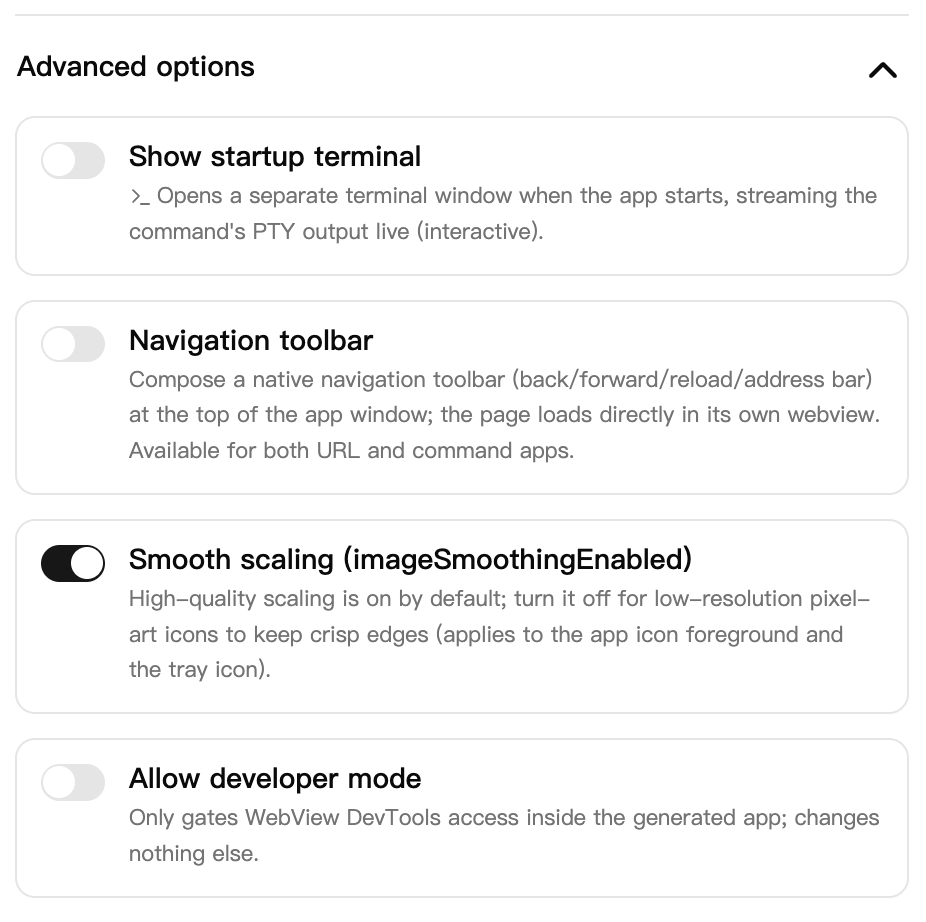
The wizard calls it "Navigation toolbar" and keeps it under Advanced options, off by default. URL apps and command apps can both enable it.
Build your own toolbar on the same principle
The official toolbar uses no private interface. Four steps, copyable:
Create a
windowOnlywindow with two webviews: the toolbar webview withbridge: { webviewId: true, messageChannels: true }, the content webview with no bridge (an arbitrary page gets no capability by default).Compose once:
column([fixed("toolbar", 44), grow("content")]).The host subscribes to the content webview's
urlChange/titleChange/loadStateand forwards URL, title, and load progress to the toolbar page over the channel. The address bar keeps no state of its own — it renders whaturlChangepushes; the progress bar isloadState-driven.Inputs and buttons in the toolbar page send commands back over the same channel; the host calls
content.navigate(url)/content.back()/content.forward(). Navigation, forward, and back are the content webview's native session history, not one the page maintains itself.
A different layout (a left sidebar beside content, a status strip on top) is a different layout document; more views are more createWebview calls and more channel targets.
Per-view events
Every webview has one push-only event family: urlChange, titleChange, focused, geometryChange, loadState, navigationAction, faviconChange. loadState is the navigation lifecycle — started / finished / failed, carrying the target URL, an errorCode on failure, and a progress (0 to 1) on phases the platform can measure. navigationAction pushes at every native navigation decision point (a link click, a form submit, a redirect — visible before it happens), and faviconChange pushes when a site changes its icon. No replay, no polling; every frame carries { windowId, webviewId, seq, ... }. Current values come from query commands: subscribe first, then query, then discard any event whose seq does not exceed the queried one — that resolves the subscription race. Overlay and titlebar safe areas project per webview and recompute inside the layout commit.
Navigation observation, blocking, and favicons
navigationAction pushes before a navigation happens: { url, navigationType, isUserInitiated? }. navigationType is the platform-honest projection over link / form / backForward / reload / redirect / other — Windows distinguishes redirects exactly and classifies user-initiated navigations as link; macOS makes no redirect distinction (they surface as other).
It observes, and it blocks. Pass a set of declarative rules to createWebview; the native UI thread evaluates them synchronously, and a match cancels the navigation before it starts with a loadState failed carrying the stable error code 4500001:
const content = await win.createWebview({
  id: "content",
  url: "https://example.org",
  favicon: true,
  navigationRules: [{ pattern: "*://*.tracker.example/*", action: "block" }],
});

content.onNavigationAction((event) => { /* every decision point */ });
await content.setNavigationRules([]); // replace the whole set later
Patterns are URL globs: * matches any character run including separators; everything else is literal. A blocked navigation produces exactly one terminal frame (navigationAction followed by failed(4500001), never a started); the page stays put and later navigations are unaffected. Synchronous evaluation means no IPC round-trip and no race window.
Favicons are a per-view capability switch in the same spirit: with favicon: true, faviconChange pushes each settled, actually-changed absolute http(s) href, and getFavicon() returns the { value: { href } | null, seq } query pair. A site script swapping the icon at runtime takes the same path as the initial one. Views created without the flag reject the query with favicon_disabled. A bridgeless content view stays bridgeless: the observation script grants the page nothing.
content.onFaviconChange((event) => { /* event.href is absolute */ });
const current = await content.getFavicon();
A toolbar can show site icons this way: subscribe to faviconChange, fetch and cache by href.
Message channels
The host and bridged pages talk over message channels: createMessageChannel({ target }) opens one targeted connection. The lifecycle is created → open → closed(reason) → destroyed, with onClose observed exactly once. Queue bounds are exact: at most 1000 messages and 1 MiB cumulative payload per endpoint, counted as the bytes of each payload's RFC 8785 canonical serialization — the same value counts identically on every platform.
const channel = await win.createMessageChannel({ target: "toolbar" });
channel.onMessage((payload) => { /* already parsed, no manual JSON */ });
await channel.post({ kind: "navigate", url: "https://example.org" });
Per-webview bridge policy defaults to all-off: a policy-less child has no bridge capability, and an arbitrary content page gets no channel by default.
Session ownership
Session ownership keys on the (appId, trayId, sessionId) tuple. A second window session for the same tray is rejected with the typed tray_session_active. Closing one session destroys exactly its own windows, webviews, channels, and popups — never another session's.
Kernel performance work
The 16 ms poll retired; extensions push
The host used to ask the native queue on a 16 ms timer whether anything new had arrived: every idle window issued 121 drain commands per 2 seconds, on both platforms.
That path is now a host-owned async port (EventPort). Every ext-* extension receives an immutable port whose thread-safe try_submit never blocks native UI or transport. Events classify as Latest (coalescing state; a sequence gap triggers a query resync), Edge (backpressured, never silently dropped), or BestEffort. Per-source and global byte/record budgets with round-robin draining keep one extension from taking another's share.
The per-view event families and the window family (focus/blur/visible/style/interaction/download) all ride that port on both platforms. One measured run: 12 events, 0 consumer commands, broker metrics matching the tap counts exactly. drainWindowEvents, its native queue, and the facade interval are deleted; drain commands from idle windows went from 121 to 0.
When urlChange or titleChange shows a sequence gap, the facade recovers with getUrl / getTitle, so Latest coalescing converges on the address bar's truth.
Messages deliver immediately
Messages from the page to the host (toolbar back/forward/reload/address jumps) enter a queue in the broker. The queue's only exit used to be the next host command's response — and after the poll retired, an idle session issues no commands, so messages waited forever. The symptom: every toolbar button dead until a Dock click happened to trigger one command that flushed the queue.
Page-originated channel commands and document-navigation closes now push host-bound messages through the EventPort immediately, with no command in flight. Messages are user data and never drop silently: records the port cannot guarantee (over the single-record cap, retry queue full, no port attached) stay in the queue and ride the next command response. Reloading the toolbar page takes the same path: the channel close notifies the host immediately, which rebuilds the channel (300 ms debounce), reinstalls the command surface, and re-seeds the address bar. A reload used to kill every window button silently until an app restart.
Stability fixes
The same batch fixed a group of crashes and hangs.
Starts no longer wedge after kill -9. Bundle and launch locks carry a PID and a token; a start automatically reclaims locks whose owner is dead. No manual cleanup.
A late cleanup cannot destroy a newer session. Window and channel teardown validate the owner tuple, so a sweep that collected stale entries cannot hit a session that registered in between.
No zombies after broker death. Pending command requests reject, event subscriptions receive a terminal notice, and generated apps exit non-zero instead of serving a shell whose backend is gone. The terminal message is identical on every platform (Linux's
ECONNRESETand macOS's close ordering differ; both now reportbroker connection closed, with the transport error oncause).One endpoint per app. The broker endpoint derives from the
appIdslug and display names never enter path segments; the same app reaches the same broker from a CLI open, a directnoderun, and a carrier cold start.Boot writes a narrative to app.log. Each bootstrap step records one structured line, and a failed start names the failing step in the log.
Other changes
WebViews identify as a standard browser by default. The bare WKWebView UA (no browser token inside
…AppleWebKit/…) sent UA-sniffing portals into a same-URL reload loop at roughly 10 navigations per second; baidu.com was the reported case. Appending the standardVersion/… Safari/…tokens by default makes the same window stable. New per-webviewbrowseroptions:userAgentas a full override;browserlikeUserAgentdefaulttrue(Windows already ships a full Edge UA, so this is a no-op there);incognitodefaultfalse;autoplaydefaultfalse.Context menu on toolbar pages. The
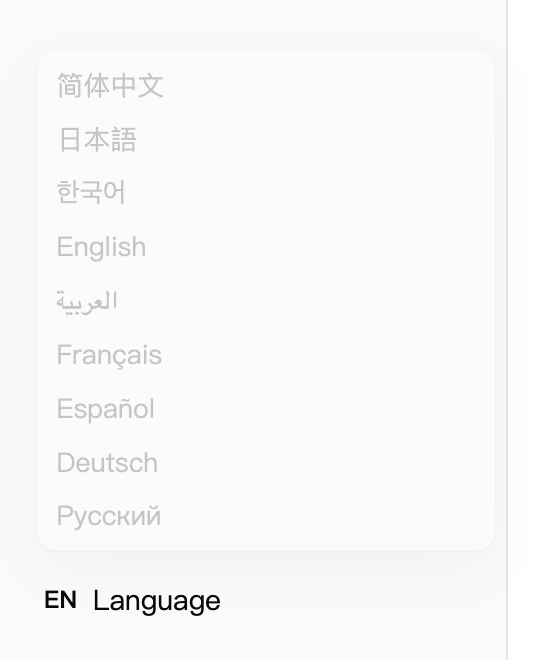
browser.contextMenuoption defaults by bridge surface: trusted shell UI like the toolbar hides the engine's context menu, so Reload and Inspect never appear on shell chrome, while a bridgeless content child keeps the ordinary browser menu. The first macOS implementation crashed at startup; it now suppresses inside the page — right-clicking anywhere on the toolbar does nothing, and the address bar's input/textarea/contenteditable keep the native menu with copy and paste.--openreplaces the running instance. open now probes for a running instance of the same app by argv identity, stops its process tree, waits bounded for the PID to release, and only then starts — instead of racing it for the broker session. A generated entry displaced by a cold launch steps aside cleanly: evidence goes toapp.log, exit code 0, no empty tray shell left behind.The wizard speaks nine languages. Simplified Chinese, Japanese, Korean, English, Arabic, French, Spanish, German, and Russian — each catalogue is one complete typed object, with
{token}placeholder parity enforced by tests. Server-emitted validation errors, fixed hints, and PTY guidance ride the same language channel (x-opentray-locale/lang=). The Arabic interface mirrors to RTL.
WebviewWindowHandle.setTitleis implemented. Generated command apps called it for the(detached)service-window marker; the method never existed on the handle, and every call threw silently.Icon generation in the packaged runtime is fixed. The glyph font (
inter-glyph.ttfwith its OFL notice) and the background PNGs used for icon composition ship in the published package, and the WASM image codec dependencies are declared; a registry install generates icons without a local checkout.Two raw-pointer FFI helpers in
opentray-specare markedunsafewith safety docs, clearing an error-level clippy lint.
Upgrade
npm i create-opentray@0.28.0
npm i opentray@0.28.0          # SDK
With official extensions, pin one protocol line: pnpm add opentray@stable-A-B @opentray/ext-webview@stable-A-B (the line tag is published by @opentray/spec; do not mix it with latest).
Links
Changelog: GitHub Release opentray@0.28.0 · opentray@0.27.7 · opentray@0.27.4 · opentray@0.27.3 · opentray@0.27.2 · opentray@0.27.1 · opentray@0.27.0 · opentray@0.26.0 · opentray@0.25.0 · opentray@0.24.0 · packages/create/CHANGELOG.md
Docs: opentray.jixoai.com · create README · ext-webview README
Upgrade: see the section above
Feedback: GitHub Issues
npm: opentray · create-opentray
On this blog: OpenTray v0.23.0 (2026-09-10, the iframe-toolbar release) · OpenTray v0.21.1
Chinese version: /zh/blog/2026-09-16-opentray-v0-24-v0-28/
